


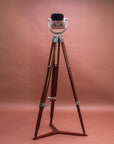
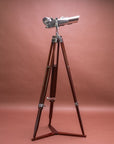
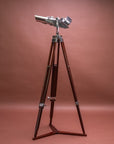
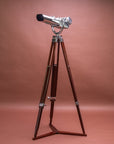
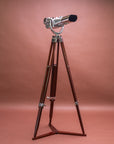
Carl Zeiss Jena WWII Binoculars, 1940s
A remarkable pair of 1940s German made Carl Zeiss Jena WWII binoculars, featuring 60 degree inclined oculars and integral filters, originally designed for anti aircraft observation and flak range finding. Made to a Carl Zeiss Jena design frequently used on flak range finders, these binoculars were typically deployed in groups of three, with two for the aimers and one for the firing technician. The oculars are inclined at 60 degrees to the horizontal, a highly intelligent feature originally intended to allow more comfortable viewing of the sky. For that reason, this model has long been regarded for both its exceptional design and its optical performance.
This particular example is especially distinctive, believed to have been produced for the French Vichy regime during the Second World War, which is why the control engravings appear in French. The result is a rare and historically layered instrument with a character entirely its own.
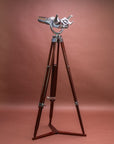
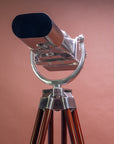
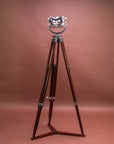
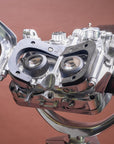
What you are seeing is a pair of silver polished Carl Zeiss Jena binoculars, with the 12 x 60 magnification marking displayed across the top plate, mounted on a 1930s military Carl Zeiss stand that has been carefully refinished to complement the piece. The binocular body has been hand stripped inch by inch, revealing the cast aluminium beneath, then polished to a brilliant mirror like lustre that gives the instrument its striking silver finish.
The optics have been meticulously restored through a time intensive process to reveal a beautifully crisp and crystal clear image. Mounted in a custom cradle and presented on a period height adjustable wooden tripod, the piece also includes a newly made wooden floor stand for added stability and protection of interior surfaces.
A dramatic statement for a home, office, gallery, or yacht, each binocular bears its own unique wartime markings and subtle distinctions. This is not simply a decorative object, but a truly singular collectible. A genuine piece of history with presence, rarity, and elegance in equal measure.

Estimated delivery time 2 to 4 days
Key Details
Schneider Optische
Wartime Code dkl
Manufactured in Kreuznach to the original design by Emil Busch.
Germany
Anti-Aircraft Observation, Flak Arm
World War II
Model Designed 1935, Adopted 1936
Original; Fully Restored
Excellent Condition
Meticulously restored, with the cast aluminium body polished to a mirror finish and the optics fully refurbished to the highest standards. The engraved markings D.F. 10×80 / △ dkl X / 42322 remain crisp and fully legible.
Aluminium, Glass, Wood
Silver Polished Aluminium Finish
37 cm
Length
Acquired from the Bossington Estate and believed to have belonged to the family of Sir Charles Richard Fairey, founder of the Fairey Aviation Company. The estate, purchased in 1937, was shared in proximity with fellow aviation pioneer Thomas Sopwith.
The German 10×80 Doppelfernrohr, with 10x magnification, 80mm objective lenses, 45° inclined oculars, and integrated filters. Originally designated a searchlight director, used for artillery and flak direction, searchlight control, and strategic surveillance.
Mounted on a custom cradle attached to a height-adjustable period wooden tripod, with a newly crafted wooden floor stand for stability and floor protection.
Authentic Wartime Optics, Not Reproductions
Original period engineering with its wartime markings intact. The real object, in a market flooded with replicas.
150 Hours of Swiss Watchmaker Restoration
Fully opened, inspected, and revived. Every prism hand polished and microscopically finished to tolerances measured in fractions of a human hair.
Restored as a Working Instrument
A crystal clear, comfortably merged image through both barrels. Built to be used, not displayed as decoration.
Nine Months to Complete
Multiple original WWII donor sets were used to bring this instrument back to life. Over those nine months, original glass, prisms and the markings plate were sourced to replace damaged or missing parts. Often disassembled again after it performs perfectly, not because it failed, but because it can still be refined.
One Serial Number in the World
Original markings make every piece historically rare. No one else in the world owns this exact instrument, and its Certificate of Authenticity proves it.
Appreciating as Scarcity Accelerates
Most originals never survived to be collected, meeting their fate at the bottom of the sea and on lost battlefields. The remaining few are disappearing into private collections while demand climbs.

It's all in the details


